How Much Should a Website Cost in 2026? A Transparent Breakdown
This article lays it out plainly. What a website actually costs in 2026, what drives the price up or down, and what the cheaper options are quietly costing you that never shows up on the invoice.
Published: May 2026 | Category: Website Design | Reading Time: 9 min
You have been quoted anywhere from $200 to $20,000 for a website. Both from people who looked confident saying it.
That gap is not just confusing. It makes it almost impossible to know whether you are getting a fair deal, being overcharged, or about to pay someone to build something that will not work. And because most business owners only buy a website once every few years, there is no easy way to build intuition around what things should cost.
This article lays it out plainly. What a website actually costs in 2026, what drives the price up or down, and what the cheaper options are quietly costing you that never shows up on the invoice.
Why Website Pricing Is All Over the Place
Unlike buying a car or hiring an accountant, website pricing has no standard. A “website” could mean a one-page portfolio thrown together in an afternoon or a custom-built platform with integrated booking, payments, and a content system that took three months to develop. Both are technically websites.
The price gap comes from four things: how much custom work is involved, who is doing it, what platform it is built on, and what the site is actually expected to do for your business.
Understanding those four variables is how you stop comparing quotes that are not actually for the same thing.
The 4 Tiers of Website Cost in 2026
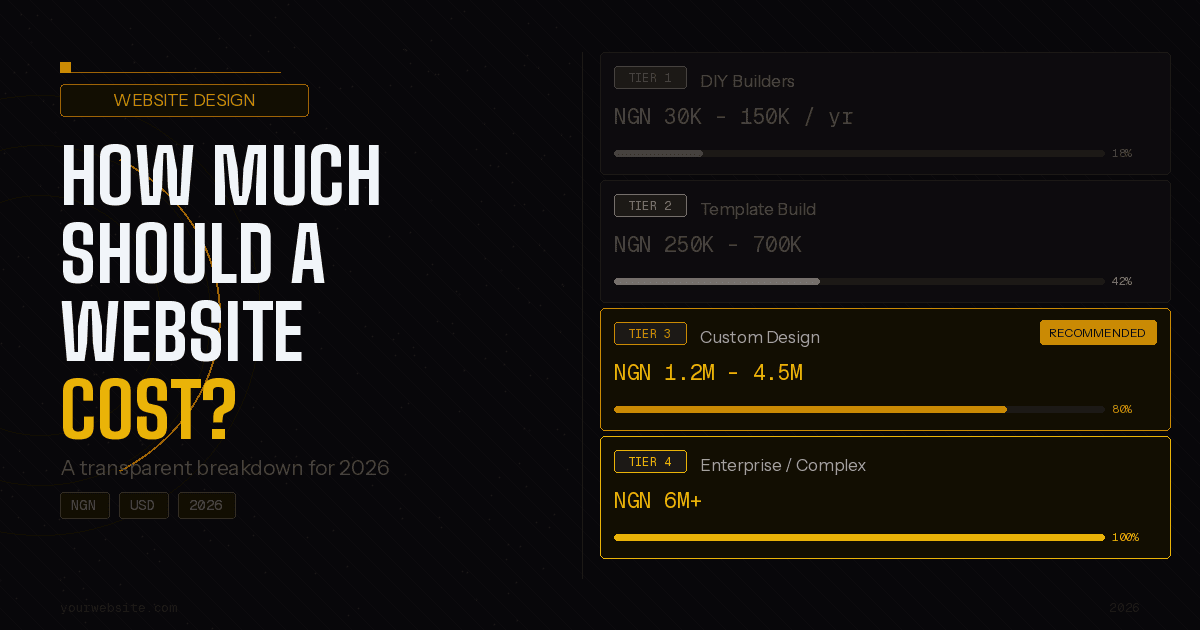
Tier 1: DIY Website Builders (NGN 30,000 to NGN 150,000 / year or $20 to $100/month)
Platforms like Wix, Squarespace, and Webflow’s free tier fall here. You are paying for a subscription that includes hosting, a drag-and-drop editor, and a library of templates.
What you get: A site you can launch quickly, usually in a day or two. Clean enough to look presentable. Comes with basic SEO settings and a mobile-responsive layout.
What you do not get: A site built around your specific customer journey. Any real differentiation from the thousands of other businesses using the same template. Flexibility when your business grows and needs something the builder cannot do. And in most cases, you own nothing. If you stop paying, the site disappears.
Who it makes sense for: A freelancer, a side hustle, or a business that genuinely just needs a digital presence and does not rely on its website to generate leads or revenue.
Who it does not make sense for: Any business that expects its website to do real work, convert strangers into leads, or reflect a brand that people should take seriously.
Tier 2: Template-Based Professional Build (NGN 250,000 to NGN 700,000 / $150 to $450)
This is a professionally built website using a premium theme or template, customized to your brand, written with your content, and set up on a platform like WordPress, Webflow, or Framer.
What you get: A site that looks custom but is built on an existing framework. Faster to produce because the design foundation already exists. A professional handling the build means proper settings for SEO, page speed, and mobile responsiveness. You own the site and can take it anywhere.
What you do not get: A design made specifically for your business logic, your audience, or your conversion goals. The template was built for everyone, which means it was optimized for no one in particular.
Who it makes sense for: Small businesses, service providers, and startups that need a credible professional site but are working with limited budgets and do not have complex functionality requirements.
Who it does not make sense for: Businesses in competitive markets where differentiation matters, or anyone whose website is a primary sales tool.
Tier 3: Custom Design and Build (NGN 1,200,000 to NGN 4,500,000 / $750 to $3,000)
This is where a proper design process begins. Custom layouts, messaging built around your specific audience, user journey mapping, and a build that is engineered for the outcomes your business needs.
What you get: A website that was designed around your customer, not around a template library. Pages structured to answer the questions your visitors actually have, in the order they need to hear them. Proper conversion architecture. A site that can be the foundation for SEO, paid traffic, and long-term growth.
What you do not get: This is not a one-week project. Done properly, a custom site at this level takes four to eight weeks from kickoff to launch, depending on scope.
Who it makes sense for: Established businesses, agencies, professional service firms, and any business where the website is directly connected to revenue. If you are running ads, investing in SEO, or selling anything with a meaningful order value, this tier is where the investment starts to make financial sense.
Who it does not make sense for: Businesses in pre-revenue stages or those who have not yet validated their offer and messaging. Build a lean site first, validate, then invest in a custom build.
Tier 4: Complex or Enterprise Builds (NGN 6,000,000 and above / $4,000+)
This covers websites with custom functionality: booking systems, membership areas, e-commerce with complex inventory, multi-language setups, API integrations, custom dashboards, or large content libraries.
What you get: A fully bespoke digital product built by a team that includes strategy, UX design, visual design, front-end development, back-end development, and quality assurance.
What you do not get: Speed or low cost. These projects typically run three to six months and require a significant budget and active client involvement throughout.
Who it makes sense for: Businesses that have outgrown off-the-shelf solutions, established e-commerce brands, startups with investor backing, and organizations that need proprietary functionality.
What Actually Drives the Price Up
Within each tier, these are the specific factors that push a quote higher:
Number of pages. A 5-page site is a different scope from a 20-page site. Each additional page requires design, copywriting, and development time.
Custom copywriting. Most quotes do not include writing your content. If you need a professional to write the copy, expect to add between NGN 150,000 and NGN 500,000 to the project depending on scope. Good copy is not optional. A beautifully designed site with weak messaging does not convert.
Integrations. Connecting your site to a CRM, booking platform, payment gateway, email marketing tool, or analytics system adds complexity and time to every build.
E-commerce. A product catalogue with shopping cart, checkout, inventory management, and payment processing is significantly more complex than a standard service site.
Ongoing support and maintenance. Most agencies offer monthly retainers for updates, security patches, backups, and performance monitoring. This typically runs between NGN 30,000 and NGN 150,000 per month depending on the level of support.
Timeline. Rushed projects cost more. If you need a site in two weeks instead of six, you are paying for the agency to rearrange other work around yours.
What a Cheap Website Is Actually Costing You
There is a number on the invoice and then there is the real cost. They are rarely the same.
A website that loads slowly, looks generic, and was not built to convert does several quiet things to your business.
It tanks your SEO. Google’s ranking algorithm penalizes slow, poorly structured sites. So even if your content is strong, a weak technical foundation suppresses where you appear in search results. You are effectively paying for content that Google will not show anyone.
It wastes your ad spend. Every business that runs Google or Meta ads and sends traffic to a weak website is burning money. Your ads can be performing perfectly and still generate terrible returns because the landing experience is broken. The ads take the blame for a website problem.
It costs you clients you never knew you had. Visitors who land on a site that does not build trust quickly leave without contacting you. You never see them. There is no bounce-rate notification that says “you just lost a client who was ready to buy.” It just does not happen.
The math on this is straightforward. If a proper website costs NGN 1,500,000 and it improves your conversion rate enough to close two extra clients per year, and those clients are worth NGN 300,000 each, the site paid for itself in under three months. And it keeps paying.
Questions to Ask Before You Hire Anyone
Before signing any proposal, get clear answers to these:
What is included in the quote and what is not? Copywriting, photography, stock images, domain, hosting, and ongoing maintenance are often excluded. Know what the full cost is before you commit.
Who owns the site when the project is done? Some agencies build on proprietary platforms you cannot take elsewhere. Always own your own website.
What platform will it be built on and why? There is no single right answer, but there should be a clear reason suited to your specific situation.
What does the post-launch support look like? What happens when something breaks? Who do you call and what does it cost?
Can you see examples of sites they have built that are similar to what you need? Not just a portfolio. Sites that are similar in complexity and purpose.
What do you need from me and when? Delays almost always come from the client side. Know what you are responsible for delivering and by when.
The Bottom Line
A website is not a cost. It is infrastructure. The same way a physical store needs a proper fit-out to make people feel comfortable enough to buy, a website needs to be built with the same intention.
The question is not “how cheap can I get this.” The question is “what does this need to do for my business, and what is the right investment to make that happen?”
For most serious businesses in 2026, that number sits somewhere between NGN 1,200,000 and NGN 3,500,000 for a custom-built site that is actually designed to work. Anything significantly below that, and you are making tradeoffs that will show up in your results.
We build websites in the Tier 3 range, starting from a proper discovery process and ending with a site your clients take seriously.
Book a free consultation and get a clear quote for your project
Already have a site and wondering why it is not performing? Read our article on why your website is quietly losing you clients. Or if you are ready to drive traffic, start with our guide on SEO in 2026.