Why SEO Is Still the Foundation: How It Drives Your Visibility in AI Search and Voice Answers
First it was social media that was going to kill it. Then paid ads. Then voice search. Now it is AEO and GEO, and a growing number of people are asking whether investing in traditional SEO still makes sense when ChatGPT, Perplexity, and Google’s AI Overviews are answering questions before anyone clicks a single link.
Published: May 2026 | Category: SEO | Reading Time: 9 min | Target keywords: AEO SEO / GEO SEO / generative engine optimization / answer engine optimization / AI search optimization 2026
Every few months, a new acronym appears and someone declares that SEO is dead.
First it was social media that was going to kill it. Then paid ads. Then voice search. Now it is AEO and GEO, and a growing number of people are asking whether investing in traditional SEO still makes sense when ChatGPT, Perplexity, and Google's AI Overviews are answering questions before anyone clicks a single link.
Here is the short answer: SEO is not competing with AEO and GEO. It is feeding them. Without a solid SEO foundation, neither of the newer disciplines can work at all. The businesses showing up inside AI-generated answers and voice search results did not get there by ignoring SEO. They got there by doing it well.
This article explains why, and what it means practically for how you should be building your content in 2026.
What AEO, GEO, and SEO Actually Mean
Before anything else, let us define the three terms clearly, because a lot of content out there uses them interchangeably when they are actually describing different outcomes.
SEO (Search Engine Optimization) is the practice of improving your website and content so that Google and other search engines rank your pages higher in traditional search results. It covers technical site health, keyword targeting, content quality, backlink building, and user experience.
AEO (Answer Engine Optimization) is the practice of formatting and structuring your content so that it gets selected as the direct answer to a query. This covers featured snippets, voice search results, People Also Ask boxes, and similar placements where the search engine surfaces an answer directly rather than a list of links.
GEO (Generative Engine Optimization) is the practice of making your brand and content visible inside AI-generated responses. When someone asks ChatGPT, Perplexity, Google's AI Overviews, or Claude a question and the AI cites a source or references a brand, that is GEO visibility in action.
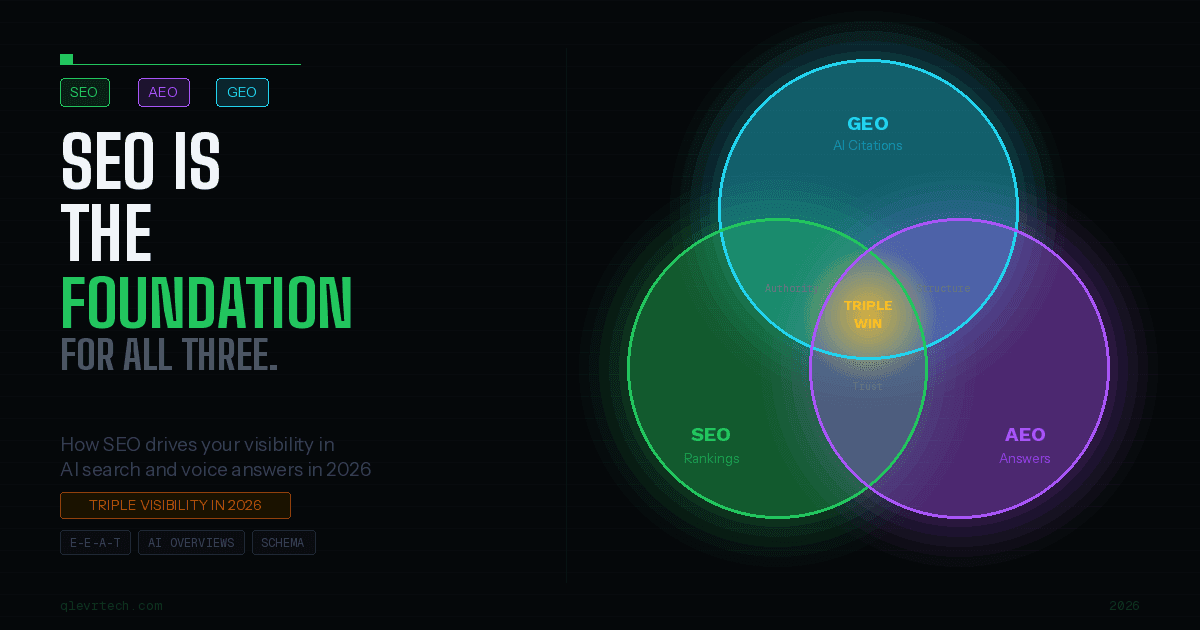
The distinction that matters most is this: SEO is about ranking. AEO is about being chosen as the answer. GEO is about being trusted enough that AI systems reference you unprompted.
Three different outcomes. But they share one common prerequisite.
SEO Is the Prerequisite for Both
This is the argument this article is making, and it is worth being direct about it.
AI models and answer engines do not pull answers from thin air. They pull them from pages that are already indexed, already structured, and already trusted. Google's AI Overviews source their information from pages that Google has already evaluated and ranked. Perplexity's web grounding prioritises pages with strong authority signals. ChatGPT's browsing tool fetches pages that are crawlable and technically sound.
A page that Google cannot crawl cannot be cited by an AI Overview. A page with no backlinks and no domain authority is invisible to the systems that AI tools use to assess credibility. A page with poor technical health, slow load times, and no structured data is functionally excluded from AEO consideration.
The signals that SEO has always been built on, domain authority, topical relevance, backlinks from credible sources, technical performance, and E-E-A-T (Experience, Expertise, Authoritativeness, Trustworthiness), are the exact signals that AI systems use to decide what to surface and what to cite.
E-E-A-T is particularly worth calling out here. Google introduced this framework to help human quality raters evaluate content. But the criteria it describes, real expertise, demonstrable experience, consistent authority in a subject area, and genuine trustworthiness, are also what AI models implicitly look for when deciding which sources to reference. You cannot shortcut to GEO or AEO visibility. The AI is borrowing trust that SEO already built.
The SEO Elements That Directly Feed AEO
AEO is not a separate system to learn from scratch. It is an extension of good SEO practice, applied with specific intent.
Structured data and Schema markup are the most direct connection. Schema tells search engines in explicit, machine-readable terms what type of content a page contains. FAQ Schema tells Google that a block of content is a question-and-answer pair. HowTo Schema tells it you are providing step-by-step instructions. Article Schema identifies the author, publication date, and subject. These tags are the translation layer between your content and the systems that select direct answers. Without them, even excellent content is harder to parse.
Direct answer formatting means writing your content so that the most important answer appears within the first 40 to 60 words of a section, before you go deeper. Search engines and voice assistants look for this pattern because it makes answer extraction reliable. If your content buries the answer at the end of four paragraphs of context, it will rarely be selected.
Featured snippet optimization requires structuring content around the formats that search engines can easily extract: numbered steps, definition blocks, comparison tables, and clear question-and-answer pairs. These formats are not just reader-friendly. They are machine-friendly, which matters in a world where machines are doing the reading.
Page speed and Core Web Vitals affect AEO more directly than many people realise. Voice search in particular deprioritises slow pages. If your LCP (Largest Contentful Paint) score is poor, your page may be ranking without being selected for voice or featured answer placements.
Conversational and long-tail keyword targeting rounds it out. People do not speak into voice assistants the way they type traditional queries. They ask full questions. Content that is written to match those natural-language queries is significantly more likely to be selected as a voice or featured answer.
The SEO Elements That Directly Feed GEO
GEO operates on a slightly different mechanism, so it is worth treating it separately even though the foundation is the same.
Topical authority is the biggest lever. AI models are more likely to cite sources that have published consistently and deeply on a subject over time. A website with 40 well-researched articles on digital marketing has more topical authority on that subject than a website with one broadly relevant post. That depth signals expertise to both Google and the AI systems that draw on its index.
Backlinks from credible and relevant sources matter here for the same reason they matter in traditional SEO. AI training data and real-time web grounding both weight pages that have earned references from authoritative sources. A link from a well-regarded industry publication signals trust. Many such links build the kind of reputation that makes a brand referenceable by AI.
Original data, statistics, and insights are cited by AI tools in a way that generic content simply is not. When an AI needs to include a specific figure or reference a source for a claim, it looks for pages where that information originates, not pages that repeat what others have already published. Creating original research, case studies, first-hand analysis, and proprietary insights gives AI systems a reason to cite you specifically.
Brand mentions across the web build entity recognition. When your brand name appears consistently in press coverage, directories, podcast transcripts, social media, and niche publications, AI models develop a stronger signal that your brand is a real, established entity in your field. This kind of recognition is not just a vanity metric. It directly influences whether an AI includes you in a response about your industry.
Structured and scannable content closes the loop. AI engines parse content in much the same way featured snippet algorithms do. Clear headers, logical sections, bullet lists, and well-labelled tables get extracted cleanly. Dense walls of text without clear structure are harder to parse and less likely to be surfaced.
Where All Three Overlap: The Triple Win
The goal of content strategy in 2026 is not to optimize separately for SEO, then for AEO, then for GEO. It is to create content that earns all three simultaneously.
When a single page is technically sound and fast loading (SEO), formatted to answer a specific question directly and clearly (AEO), and written with original expertise and backed by a credible, authoritative site (GEO), it becomes eligible for every channel at once.
That page can appear in a traditional Google ranking. It can be pulled as a featured snippet. It can be selected as a voice search answer. And it can be cited by AI Overviews, ChatGPT, or Perplexity in response to a relevant query.
A concrete example: a well-researched FAQ page on a topic your business owns, built with FAQ Schema markup, written so each answer opens with a direct one-sentence response, hosted on a domain with strong backlinks and topical authority, and published by an author with visible credentials. That page is doing all three jobs at once. That is the triple win, and it is available to any business willing to build their content with all three frameworks in mind from the start.
What This Means for Your Content Strategy in 2026
If you are planning your content for the next six to twelve months, here is what this framework means in practice.
Stop creating content for search engines and start creating it for questions. Every piece of content should set out to answer one specific question better than any other page on the internet. When you do that, SEO, AEO, and GEO alignment follows naturally.
Audit your existing content for AEO and GEO signals, not just keyword rankings. Pages that rank but do not have Schema markup, do not open with direct answers, and do not include original insights are leaving visibility on the table across all three channels.
Add Schema markup across your site systematically. FAQ, Article, HowTo, Organisation, and BreadcrumbList are the most impactful starting points for most business websites. This is not optional in 2026. It is the baseline.
Build topical authority before chasing volume. A smaller number of deeply researched, well-structured articles on a specific subject will outperform a large number of thin posts in SEO, AEO, and GEO simultaneously. Depth wins.
Invest in original content. Commission surveys, publish case studies, document real client outcomes, share first-hand analysis. Give AI systems a reason to cite you rather than your competitor.
The Businesses Winning AI Visibility Did Not Skip SEO
There is a temptation to treat AEO and GEO as shortcuts to visibility in a world where traditional rankings feel harder to achieve. They are not shortcuts. They are extensions of the same discipline.
The brands appearing inside AI answers today are not there because they figured out some new trick. They are there because they spent the last several years building technically sound websites, publishing genuinely useful content, earning credible backlinks, and establishing real authority in their space. AEO and GEO rewarded that work. They penalised shortcuts just as much as traditional SEO always did.
If your SEO foundation is weak, no amount of GEO or AEO tactics will fix the visibility problem. But if your SEO foundation is strong, both become natural extensions of what you are already doing.
At QLEVR, we build SEO strategies that account for how search actually works in 2026, with AEO and GEO built into the content and technical approach from day one, not treated as afterthoughts.
Get a Free SEO audit that covers traditional rankings, AEO, and GEO signals